
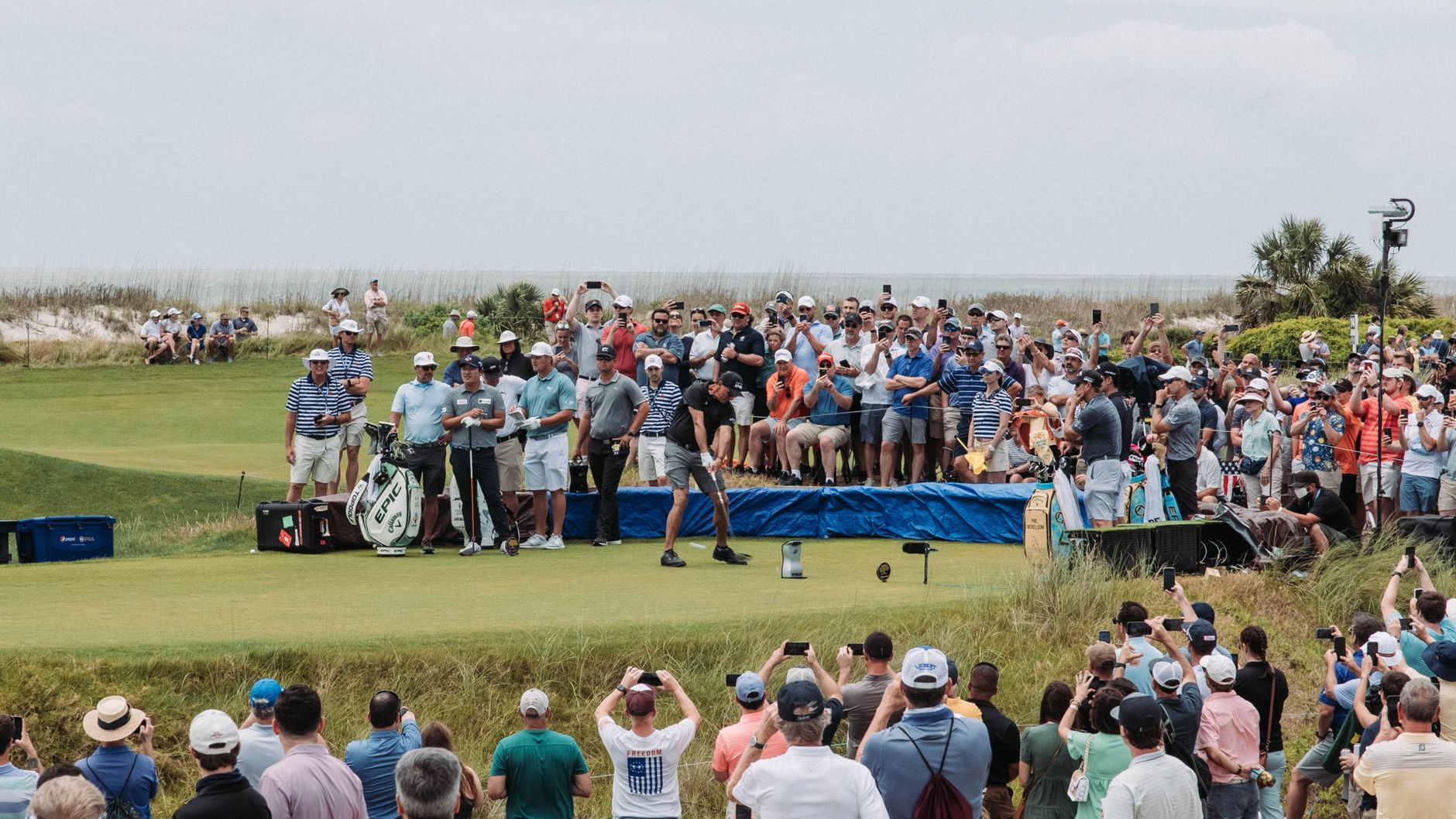
SOUTHPORT, England — The rules of golf are not ambiguous about what Bryson DeChambeau did at the fifth hole Friday. Video footage reviewed by R&A officials showed DeChambeau trampling down fescue grass to improve his backswing path, a violation that carries a two-shot penalty. What happened after the ruling was handed down is where the story left the scorecard and entered the theater.
DeChambeau argued his case, lost, and then threatened to withdraw from the Open Championship. He stayed at Royal Birkdale hitting balls deep into the Southport night before ultimately deciding to tee it up Saturday morning. The episode delayed the tournament — players, volunteers, officials all waiting on a verdict that had already been rendered.
Max Homa, who was among the early wave Saturday, pushed back against any suggestion that DeChambeau had acted deliberately. “He would never cheat,” Homa said, per ESPN. The defense was categorical, and it landed against a backdrop where most players in the field were offering carefully hedged no-comments.
Rory McIlroy was not among them.
After signing for a one-under 69 in the third round, McIlroy told reporters he had watched the incident live from the players’ lounge. “As soon as he made the step into the ball, we all sort of looked at each other, and we were like, that didn’t seem right,” McIlroy said. “When I heard that he was called in by the rules officials, I think we all … it was pretty obvious for why.”
McIlroy did not bother separating intent from carelessness. “Whether it was careless or whether it was intentional, I don’t think it matters,” he said. “Hopefully it was careless, but I think the two-shot penalty was justified for sure.”
Then came the broader critique — the one that had nothing to do with Rule 8.1a and everything to do with what happened after the ruling. McIlroy called DeChambeau’s behavior “performative” and said “a lot of it’s for attention.” He saved his sharpest line for the withdrawal threat: “To hold the tournament hostage like that, and to have all of us, players, volunteers, everyone waiting on him to depart, I didn’t feel like it was a great look.”
The two-shot penalty is the cleanest data point in all of this. It is the prescribed sanction for improving the area of intended swing. There is no discretion in the number. The only variable was whether DeChambeau accepted it gracefully, and by every account — including the late-night range session that preceded his decision to stay — he did not.
The McIlroy-DeChambeau friction predates Royal Birkdale. DeChambeau’s defection to LIV Golf placed him on the opposite side of a divide McIlroy spent two years defending as the PGA Tour’s most visible voice. DeChambeau also complained publicly last year that McIlroy ignored him during the final round of the Masters. None of that history was going to produce a measured response from either man, and none of it did.
What remains is a two-shot penalty that cost DeChambeau exactly what the rulebook says it should cost him, and a withdrawal threat that cost him something the rulebook cannot measure.
Sources
- Yahoo Sports / Golf Digest — McIlroy sounds off on DeChambeau
- ESPN — Max Homa: “He would never cheat”