
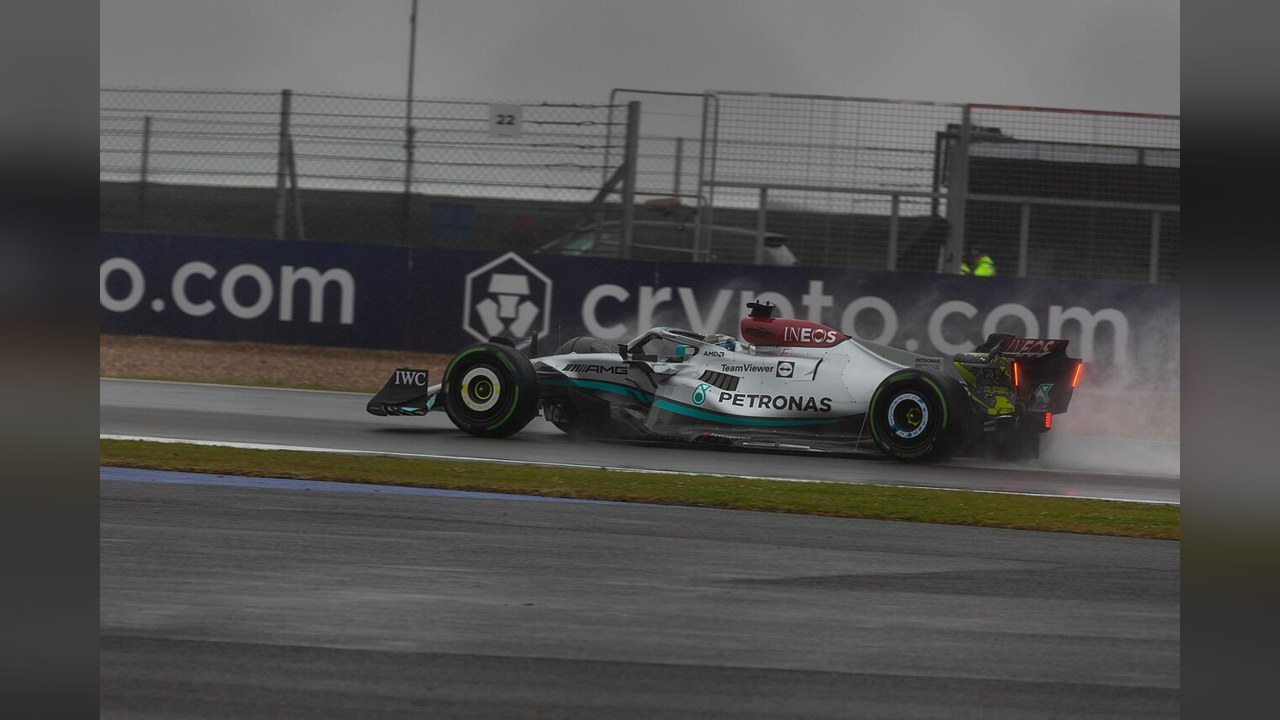
George Russell’s Belgian Grand Prix lasted less than one lap. The championship implications will last considerably longer.
Russell retired on the opening lap of Sunday’s race at Spa-Francorchamps after contact with Ferrari’s Lewis Hamilton at Turn 5, the Les Combes complex. Starting third, Russell lost three positions on the Kemmel Straight — the kind of top-speed deficit that had haunted him all weekend — before drawing alongside Hamilton into the corner. Hamilton understeered into Russell’s path, clipping the Mercedes’ right rear wheel and spinning him into the gravel trap. The safety car deployed for four laps. Hamilton received a five-second time penalty for causing a collision.
On team radio, Hamilton called it an “impossible position,” saying he was trailing Max Verstappen’s Red Bull closely and lacked the front-end grip to avoid contact. “Car crossed over right in front of me,” he told media afterward.
Russell, though, pointed the finger not at his former teammate but at his own car. He had been hemorrhaging straight-line speed all weekend — trailing Mercedes teammate Kimi Antonelli by as much as four tenths in Q3 and surrendering up to seven tenths in Friday’s second practice session. At Spa, where the Kemmel Straight and the long run to Blanchimont dictate lap time, that deficit is a competitive death sentence.
“I got completely swallowed up down the straight,” Russell told Sky Sports F1. “Lost three positions down the straight, down into Turn 5, and then the incident was a racing incident. Maybe I could have gone a bit wider, maybe he could have braked a bit more. The incident shouldn’t have happened if I had the speed down the straight.”
The straight-line problem has no diagnosis. Russell confirmed before the race that he and the team had ruled out driving style as the cause; the gap to Antonelli, running the same machinery, was rooted in how the car was deploying energy. His steering wheel’s telemetry showed the car losing velocity on the straight while the throttle was fully depressed — no lever left for him to pull. Mercedes team principal Toto Wolff said before qualifying that the engineering team had “literally left no stone unturned” without finding a root cause.
Russell arrived at Spa carrying genuine momentum. He had trimmed Antonelli’s championship lead from 68 points to 25 over the previous several rounds. A podium looked like the floor; a win was realistic. Instead, with Antonelli leading from pole, Russell’s 25-point deficit is set to balloon again — the kind of swing that compounds over a season. He was reportedly holding back tears during the interview.
“I don’t know what to say. No words at the moment,” he said. “Appreciate everyone’s working hard to solve the problem, but I’m sitting here on lap five of the race — felt like I was in a good position to fight for the lead into Turn 1, and then suddenly no power and it’s all gone.”
The box score will read: Lap 1, contact, DNF. The underlying numbers tell a different story — one about a car that can’t deploy its energy on the straights, a problem Mercedes can’t diagnose, and a title fight that may have slipped beyond one driver’s reach through no fault of his own.
Sources
- AP via Yahoo Sports — George Russell out of Belgian Grand Prix
- Motorsport.com via Yahoo Sports — Russell out after Hamilton contact
- Yahoo Sports — Russell reacts to DNF at Belgian GP
- Yahoo Sports — Russell close to tears after crash