
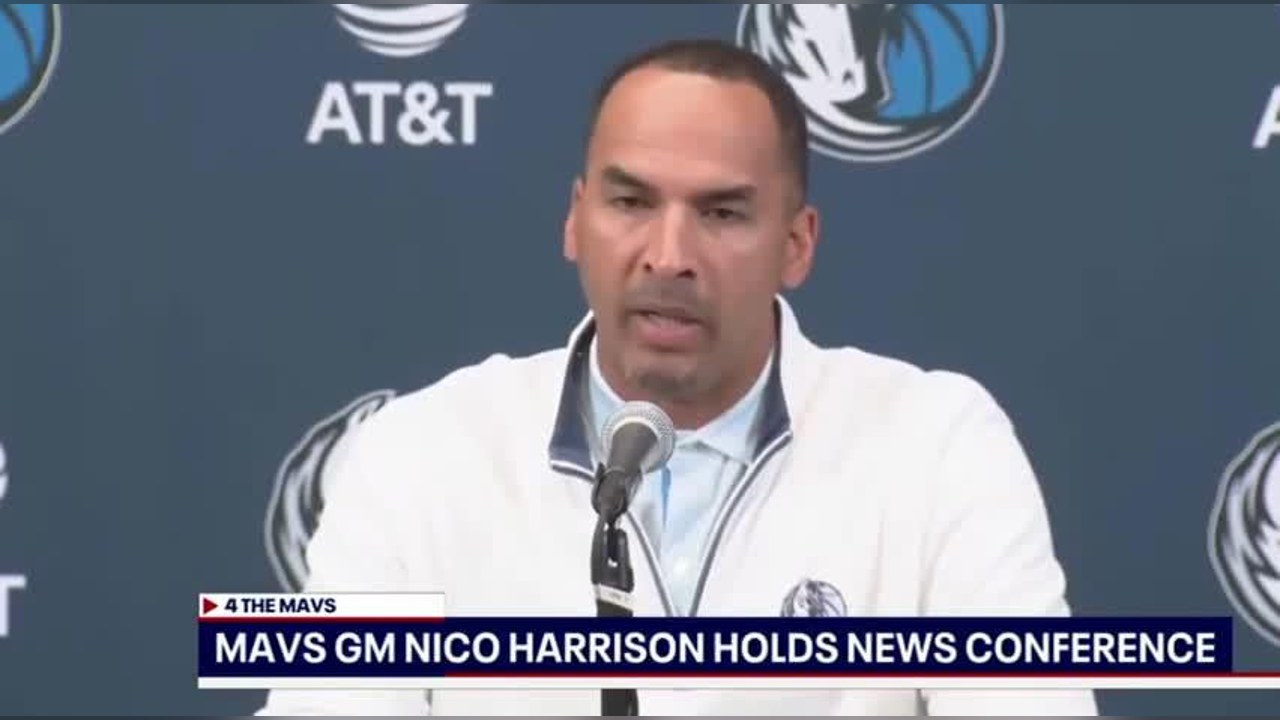
Nico Harrison finally faced cameras Monday. The Mavericks general manager had spent the months since the Luka Doncic trade avoiding exactly this — first with a closed-door roundtable that banned recording devices, then with near-silence while “Fire Nico” chants echoed through the American Airlines Center.
Now, at his season-ending news conference, Harrison offered an admission that circled the internet within minutes: “I did know Luka was important to the fan base. I didn’t quite know it to what level.”
He felt the level, though. “When you have 20,000 people chanting ‘Fire Nico,’ you feel it,” he said.
The trade that detonated Dallas basketball arrived Feb. 1, engineered in private between Harrison and Lakers GM Rob Pelinka — two men whose relationship dates to Harrison’s Nike executive days and Pelinka’s time as a player agent. Doncic, Maxi Kleber, and Markieff Morris went to Los Angeles. Anthony Davis, Max Christie, and a 2029 first-round pick came back. Doncic never hit the trade block. There was no bidding war. A 25-year-old with the third-highest career scoring average in NBA history — a player one season removed from an NBA Finals appearance — was moved for a package that most of the league’s front offices considered light.
Harrison’s rationale never wavered: “Defense wins championships.” Davis is a five-time All-Defensive selection and three-time blocks leader. Doncic’s defensive limitations are well-documented. The analytics support the premise that rim protection moves win probability more than perimeter scoring does in the postseason. The problem is that Harrison traded the engine to upgrade the chassis, and the chassis never got on the road.
Davis suffered an adductor injury two quarters into his Mavericks debut. Kyrie Irving tore his ACL shortly after. Role players dropped. Dallas got so thin they flirted with a forfeit. They scraped into the play-in tournament and lost to Memphis. The championship-caliber starting five Harrison envisioned — Irving, Klay Thompson, P.J. Washington, Davis, Dereck Lively II — never shared the floor.
Harrison told reporters he wasn’t instructed by team governor Patrick Dumont to make the deal, and that the move wasn’t about avoiding Doncic’s looming $345 million supermax eligibility. “There wasn’t a straw that broke the camel’s back,” he said. “It was more about the change of philosophy.”
Doncic’s return to Dallas in the regular season’s final week crystallized what Harrison said he failed to grasp. The crowd roared louder for a visiting Laker than for the home team. Doncic scored 45. The “Fire Nico” chants competed with the cheers for the prodigal star. The box score said one thing. The arena said another.
Harrison defended his four-year tenure — “I think I’ve done a really good job here” — and said he expects Irving to exercise his $44 million player option for 2025-26. He acknowledged the franchise’s communication with fans and media fell short. He insisted he wasn’t running from scrutiny, despite the evidence of months spent doing precisely that.
“I believe winning will help repair the relationship with the fans,” Harrison said. That is a bet on a roster that is cap-constrained, aging in key spots, and built around a 33-year-old center with an extensive injury history and a point guard who will spend the offseason rehabilitating a reconstructed knee. The math is not encouraging. But Harrison has been making bets against the numbers all year.