
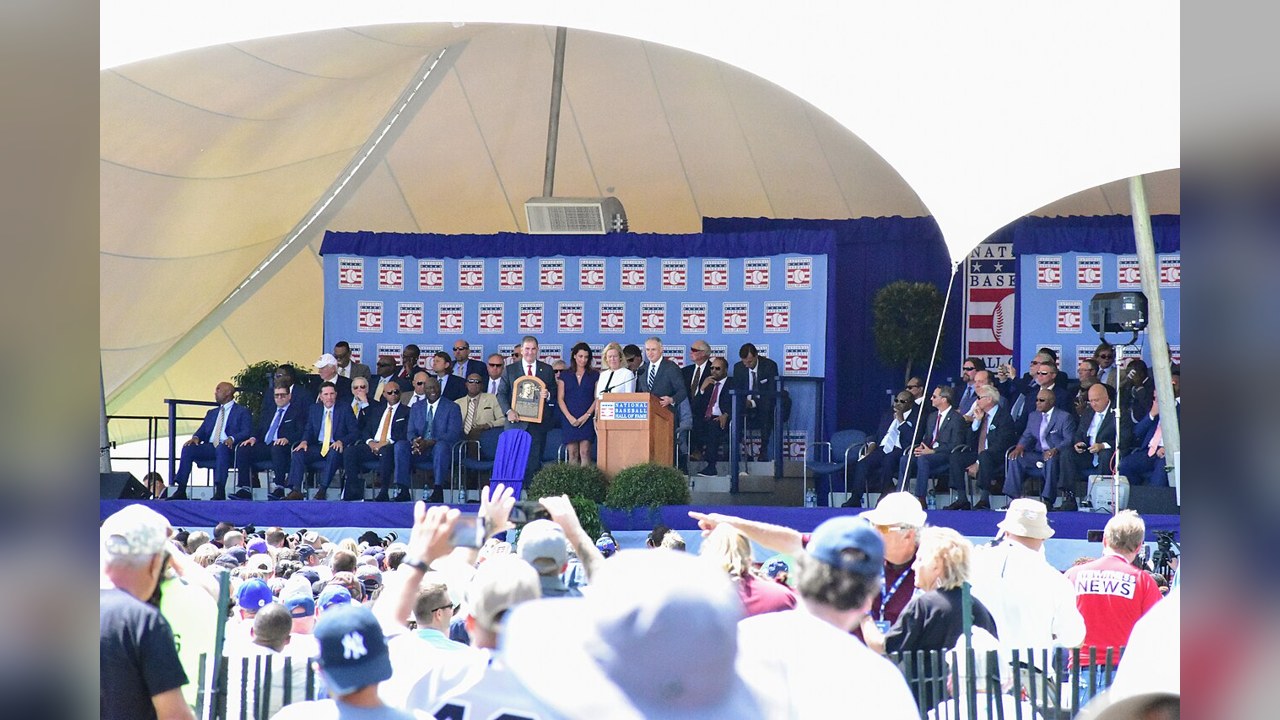
Carlos Beltran stood at the podium in Cooperstown on Sunday afternoon, a Mets cap on his head, and took his place among baseball’s immortals. Jeff Kent and Andruw Jones joined him. The ceremony was the culmination of a career that produced 435 home runs, 312 stolen bases, and nine All-Star selections across seven franchises.
It also produced the most uncomfortable Hall of Fame conversation in years.
Beltran was the only player explicitly named in MLB’s official investigative report into the Houston Astros’ 2017 sign-stealing scheme — a operation that involved stealing opponents’ signs using a center-field camera and relaying pitches to hitters by banging a trash can in the dugout. The scandal cost Astros manager A.J. Hinch and general manager Jeff Luhnow their jobs, both suspended for a full season by Commissioner Rob Manfred. Beltran, who was a veteran presence on that 2017 roster, had already retired by the time the report dropped in January 2020. He had, however, just been hired as the Mets’ manager three months earlier. He and the club mutually agreed to part ways before he managed a single game.
“It means a lot when I think about my career and I think about the choices that I had,” Beltran said Sunday in a video conference, discussing his decision to enter Cooperstown with a Mets logo rather than a Royals cap or no logo at all. “I felt that I was able to grow the most with the Mets, in every experience that I had there. The good ones, the bad ones, the controversies, whatever.”
In 839 games with the Mets, Beltran slashed .280/.369/.500 with 149 home runs, 559 RBI, 100 stolen bases, and a 31.1 WAR — the highest WAR he accumulated with any of his seven clubs. He currently serves as a special assistant to Mets president of baseball operations David Stearns, and his name has surfaced as a potential managerial candidate for the club in recent weeks. Beltran said he discussed the role with the organization but did not feel stepping in as interim manager was the right move.
His induction, though, has cracked open a debate that baseball would rather leave sealed. Barry Bonds — the all-time home run leader with 762, the single-season record holder with 73, a seven-time MVP — spent ten years on the Baseball Writers’ Association of America ballot and never reached the 75% threshold required for enshrinement. His final year of eligibility, 2022, topped out at 66.0%. Bonds never failed a PED test during his playing career. For the majority of his career, Major League Baseball did not test for performance-enhancing drugs at all; survey testing did not begin until 2003, and penalties were not enforced until 2004. Bonds was convicted of obstruction of justice in 2011 for a rambling answer before a grand jury investigating the BALCO lab, but that conviction was overturned on appeal in 2015.
The contrast has drawn sharp reactions across the sport. One player was named in an official MLB report as central to a scheme that corrupted the integrity of on-field competition during a championship season. The other put up numbers that no human being has ever matched, in an era when the substances voters hold against him were not yet prohibited by the game he played. Voters weighed one and shrugged at the other.
Beltran, for his part, spoke about his role in the Astros scandal at the time of his departure from the Mets, saying there was no scenario in which MLB would allow him to manage after other members of the Astros coaching staff were suspended. He has not dwelled on it publicly since.

The Hall of Fame plaque now hangs. The debate does not.
I’ve coached enough film sessions to know this much: you can argue scheme all day, but the tape tells you what happened. Beltran’s name is in that Manfred report. Bonds’ name is in every record book the sport keeps. The voters decided which one mattered more. The film doesn’t lie — but it sure depends on who’s holding the remote.
Sources: