
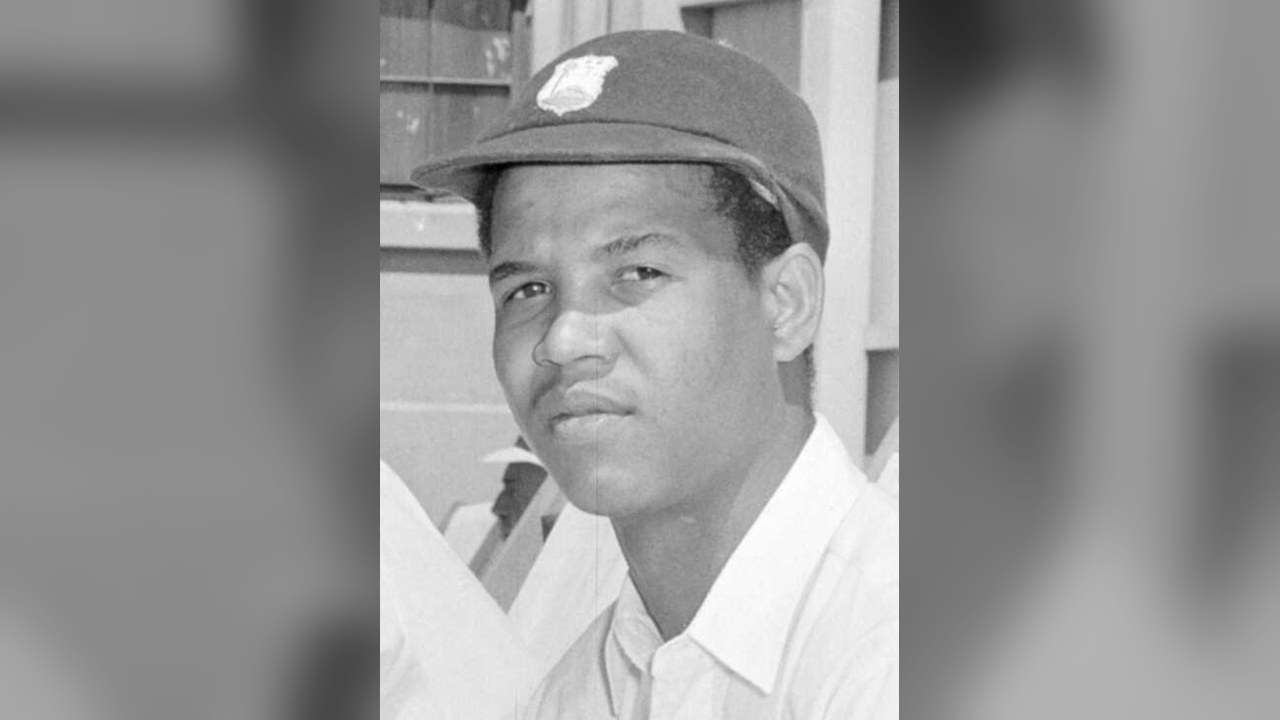
Sir Garfield Sobers, the West Indies all-rounder widely regarded as the greatest cricket player ever to lace up spikes, died Friday at the age of 89. His son, Daniel, confirmed the death. Sobers was 10 days short of his 90th birthday.
West Indies Cricket announced the news on X with a photograph titled “Legend, Icon, Hero” and the words: “A great innings has come to an end. In our hearts, now and forever, Sir Garfield Sobers.”
The Barbados-born Sobers played 93 Tests for the West Indies between 1954 and 1974, scoring 8,032 runs at an average of 57.78 and taking 235 wickets at 34.03. He made his Test debut as a 17-year-old against England, initially selected for his bowling before establishing himself as one of the game’s most destructive batters. He could bowl left-arm fast-medium, orthodox spin, and wrist spin — the kind of versatility that, in a different sport, would make a coach’s jaw hit the locker room floor.
His defining performance came in 1958 at Sabina Park in Kingston, Jamaica. At 21, Sobers smashed an unbeaten 365 against Pakistan, breaking Len Hutton’s world record for the highest individual Test score. The record stood for 36 years until another West Indian, Brian Lara, surpassed it with 375 against England in 1994 — with Sobers on hand to celebrate.
A decade later, in 1968, Sobers became the first batter in first-class history to hit six sixes in a single over, teeing off against Glamorgan’s Malcolm Nash while playing county cricket for Nottinghamshire. The feat remains one of cricket’s most replayed moments.
Sobers captained the West Indies in 39 Tests between 1965 and 1972, winning nine and losing 10. Across a first-class career spanning 383 matches, he amassed 28,314 runs at an average of 54.87, with 86 centuries, and claimed 1,043 wickets. He was knighted by Queen Elizabeth II in 1975.
Wisden named him one of its Five Cricketers of the 20th Century, alongside Donald Bradman, Jack Hobbs, Viv Richards, and Shane Warne. Bradman himself offered what amounts to the ultimate endorsement in that sport: “He is, in my opinion, the greatest cricketer of all time.”
The International Cricket Council’s highest individual honour for men’s cricket — the Sir Garfield Sobers Award — bears his name.
West Indies CEO Chris Dehring called Sobers “a towering figure whose influence on our game and our region can never be overstated.” In a statement, Dehring said Sobers was “the embodiment of West Indies cricket at its finest — bold, brilliant, innovative and unapologetically excellent.”
ICC chairman Jay Shah said the sport had lost “one of its icons,” calling Sobers “not only the finest all-rounder the game has ever known, but one of the greatest cricketers in history.”
Nottinghamshire, his former county club, described him as “cricket’s greatest-ever all-rounder and an iconic figure in the club’s history.” England Cricket posted: “One of the greatest to ever play the game. Forever in our hearts, Sir Garfield Sobers.”
Former England batsman Geoffrey Boycott, writing in the Telegraph, remembered the way Sobers carried himself to the crease. “He didn’t say anything. He did not need to. There was no ego,” Boycott wrote. “His walk let the opposition know he was there for business.” He described Sobers as “like a panther with a purposeful, loping and confident walk.”
Sobers finished his Test career as the fourth-highest run-scorer and eighth-highest wicket-taker in West Indies history. The film doesn’t lie.
Sources:
- Yahoo Sports — ‘Great innings ends’: Cricket mourns West Indies great Sobers
- Yahoo Sports — West Indies legend Garry Sobers dies at 89