
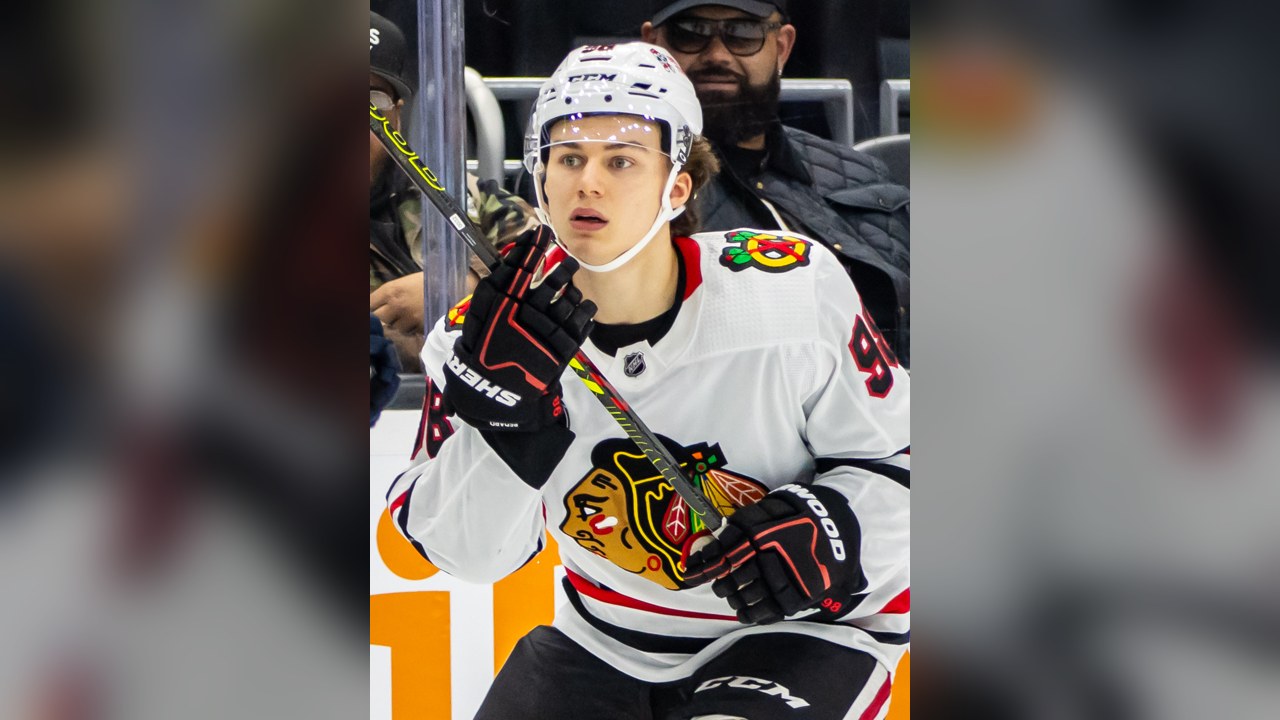
Connor Bedard outpointed Leo Carlsson 203-141 across their first three NHL seasons. He went first overall in 2023; Carlsson went second. He is the face of an Original Six franchise in the third-largest media market in North America. By every reasonable valuation model, Bedard should command the highest salary in the league.
He does not. On Saturday, the Blackhawks signed their 21-year-old center to a five-year extension carrying a $15 million cap hit — third in the NHL behind Carlsson’s $18 million AAV (set via Philadelphia’s offer sheet) and Kirill Kaprizov’s deal with Minnesota. Bedard could have asked Chicago for $18 million. He almost certainly would have received it.
He told his agents not to.
When the Flyers landed Carlsson on that five-year, $90 million offer sheet, sending shockwaves through the league’s economic architecture, Bedard’s camp didn’t flinch. “Connor made it clear even after the offer sheet — and before the offer sheet — that he had no intention of signing an offer sheet, that he was happy in Chicago, believed in the organization, believed in his teammates, and was quite content and happy to stay exactly where he was,” Don Meehan, Bedard’s agent, told The Athletic.
The real negotiation wasn’t about dollars. It was about term. Recent stars exiting entry-level deals — Connor McDavid, Leon Draisaitl, Jack Eichel — locked in for the maximum eight years. Bedard’s camp initially floated a shorter deal, one that would have put him back on the market at peak leverage with the salary cap climbing at roughly 8 percent annually. GM Kyle Davidson pushed back, arguing the organization needed the stability of a longer commitment. They settled at five, a deal that expires when Bedard is 26 and buys out only one year of unrestricted free agency.

“That would have really placed Connor in absolute control,” Meehan said of the shorter-deal scenario. “But he became sensitive to Chicago’s need for stability and continuity. And Kyle felt he needed to send a signal internally and externally that Connor was there for not just a short period of time, but a longer period of time.”
Here’s where the numbers and the narrative diverge. Bedard is leaving real money on the table — $3 million in AAV against his closest comparable, on a deal that will likely look like a bargain by its midpoint if the cap keeps rising at the projected rate. And yet the roster around him remains thin. The Blackhawks have finished in the bottom three three straight seasons. Davidson aggressively acquired defenseman Bowen Byram from Buffalo this offseason — surrendering the fourth overall pick, a second-rounder, and Louis Crevier — and immediately signed him to six years at $12.5 million. That addresses the blue line. Up front, Bedard still lacks a proven top-line winger. Roman Kantserov, who led the KHL in goals as a 21-year-old, gets the first look.
Then there’s the shoulder. Bedard suffered the injury during a training session in Burnaby, B.C., this month. He had the option to rehab and potentially avoid surgery, but the risk was four to six weeks of rehabilitation followed by surgery anyway — a worst-case timeline that would have cost him more of the season. He opted to go under the knife immediately. Meehan said the surgeon later called it a “wise decision” because the shoulder was unstable and wouldn’t have responded to rehab alone. Bedard is expected to miss roughly the first six weeks of the season.

The injury did not affect negotiations, Meehan said. The contract got done anyway, and Bedard’s commitment never wavered. “He doesn’t suffer any constructive criticism of the team or his teammates well,” Meehan said. “He doesn’t tolerate that. He believes, and he’s totally committed.”
Whether that commitment is rewarded with a roster worthy of it remains the question the cap sheet can’t answer.