
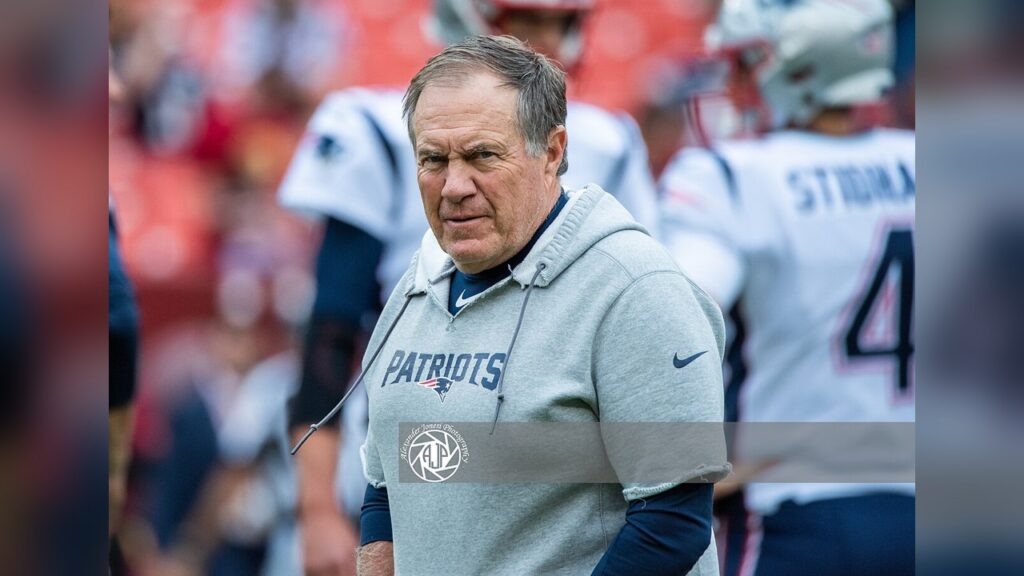
Bill Belichick Calls for NCAA and NFL to Standardize Playing Rules
After a half-century in professional football, Bill Belichick spent his first season in the college game encountering the kind of structural inconsistencies that would have driven him up a wall in Foxborough. Now, entering his second year at North Carolina, he is saying so out loud.
Speaking Friday at the National Football Foundation’s Bill Dooley Chapter Pigskin Preview in Raleigh, Belichick called for the NCAA and NFL to adopt a single set of playing rules — a long-standing divergence he framed as a problem for everyone who touches the sport.
“The one thing I’ve always advocated is for college football and pro football to have the same set of rules,” Belichick said, via Kamran Nia of the Raleigh News & Observer. “I think that would make it a lot easier and a lot better for the fans, the players, the coaches, the officials and everybody that watches the game.”
The gaps are not subtle. College receivers need one foot inbounds; NFL receivers need two. Defensive pass interference is a 15-yard penalty in college and a spot foul in the pros — a difference that can swing 40 or 50 yards of field position on a single flag. The NFL’s redesigned kickoff, which dramatically altered return rates and field-position math last season, has no college equivalent. College football only added a two-minute warning last year, and even then gave it a different name. The clock still stops after first downs on Saturdays and does not on Sundays.
Belichick pointed to the whiplash of a football weekend: “You watch multiple games on Saturday and see one set of rules — interference penalties, overtime rules, timeouts; there are multiple differences, and you don’t see that in other sports. And then you turn on the game on Sunday, and you have a different set of rules.”
He singled out the targeting rule as a case where players internalize one standard for four or five years and then face a different framework the moment they arrive in the league. “Players have learned that targeting rule through their entire college career, and then they go to the NFL, then the rules are a little bit different for targeting,” he said.
Whether anyone beyond Belichick will push the issue is another matter. Standardizing the rulebooks would almost certainly mean the NCAA bending toward NFL standards, not the reverse — the NFL has no incentive to recalibrate its product to match college football. And despite the friction the differences create for player development and officiating, there has rarely been organized pressure to resolve them. Belichick’s platform at Chapel Hill gives the idea a prominent voice it has not previously had.
The Pigskin Preview panel — which also included N.C. State’s Dave Doeren, Duke’s Manny Diaz, N.C. Central’s Trei Oliver, and East Carolina offensive coordinator John David Baker — ranged well beyond rulebook mechanics. Belichick described the transfer portal’s older, more developed talent pool as easier to evaluate than high school prospects, but flagged the growing influence of agents directing players to destinations within 48 hours of entering the portal. He called the problem of tampering “above my pay grade” and said conference-level enforcement was the only realistic mechanism, while doubting conferences would police their own members.
Doeren, for his part, argued the sport’s competitive imbalance stems less from the portal than from the absence of a shared spending structure. “The NCAA is supposed to be about creating a level playing field with the rules, and there is nothing level about the amount of money schools have to go get their rosters or retain their rosters right now,” he said.
Belichick’s rules proposal may be the simpler fix. Whether simplicity is enough to move two bureaucracies that have operated independently for decades is a question no amount of film study can answer.
Sources: