
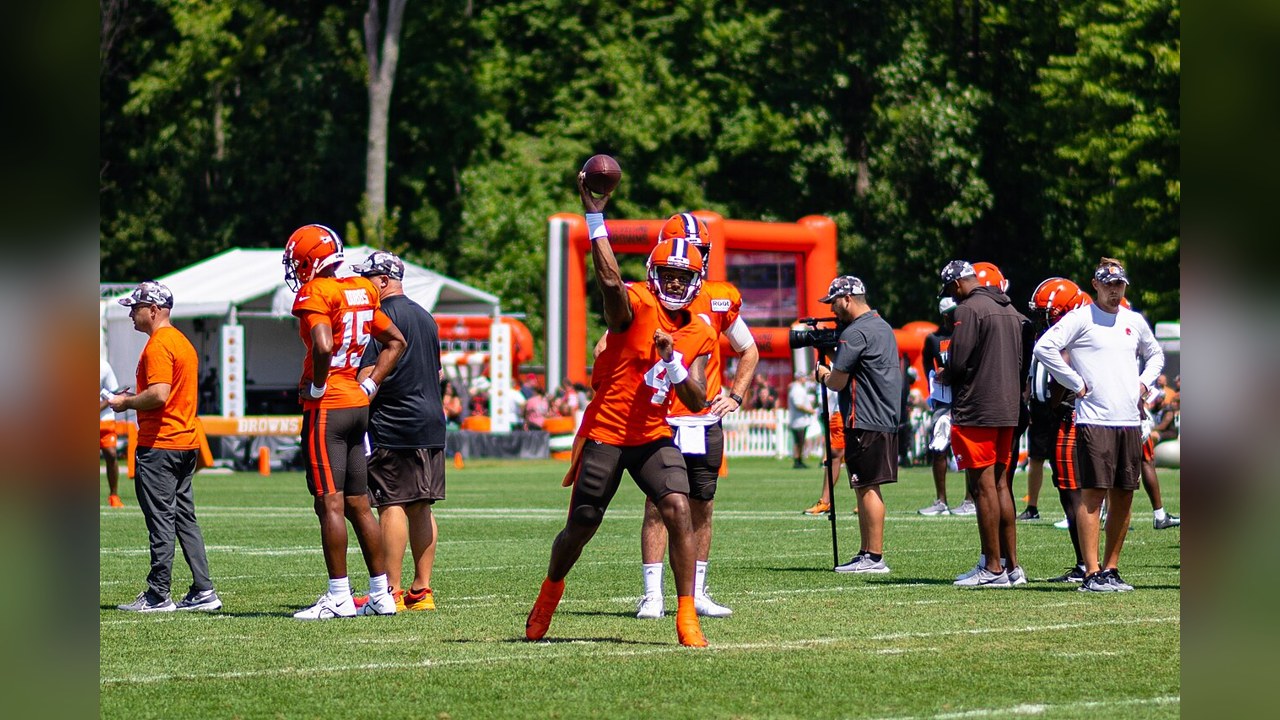
Mike Florio found a single rep and built a referendum around it. The Pro Football Talk analyst dissected a clip from Cleveland Browns OTAs — a fake-pitch drill — in which Deshaun Watson executed the sequence cleanly and delivered a sharp throw, while rookie Shedeur Sanders appeared to coast through the same action. In a quarterback competition where every visible detail gets catalogued by the coaching staff, Florio argued, that contrast is not nothing.
“You can’t win the job if this is how you’re going to approach these drills,” Florio said, framing what he believed a coach might tell Sanders. “You’ve got to put everything into it, or Watson is the guy who’s going to earn the job. And by the time that we go play, the decision will have been made.”
The Browns’ quarterback room includes Sanders, Watson, and third-round pick Dillon Gabriel, but the real competition is the two-man race between the fifth-round rookie and the $230 million veteran. Sanders arrived in Cleveland with momentum — the kind that comes from a productive college career and a fan base eager for a fresh chapter. Watson arrived with a contract entering its final year and a medical file that reads like a worst-case scenario: an 11-game suspension in 2022, a rotator cuff injury in 2023, a ruptured Achilles in 2024, and a second Achilles rupture on the same leg that cost him the entire 2025 season. He has appeared in 19 games over the past five years combined.
That is the statistical backdrop Florio’s film-room critique runs into. Watson does not need to be dominant to win the job, the argument goes — he just needs to look like the more serious competitor in drills that most of the football world treats as voluntary window dressing. If Sanders is a gamer who shows up on Sundays and checks out in May, that split only works if the staff decides to look past the practice tape. Florio’s read is that Cleveland’s staff has not made that decision.
NFL Network’s Tom Pelissero offered a different lens. Speaking on “The Rich Eisen Show,” Pelissero acknowledged Watson’s contract and injury history — the $230 million albatross, the 19 games in five seasons — but reported that the Browns’ staff came away from OTAs and minicamp seeing genuine improvement from both quarterbacks.
“From what I’ve been told, there really was growth through the spring. He did improve,” Pelissero said of Sanders. “Is that enough to be able to catch Deshaun Watson? … they came away thinking they got two guys they can go out there and play with.”
Two analysts, two data points. Florio is drawing conclusions from one rep in one drill in one voluntary practice — a sample size that would get laughed out of any serious evaluation if it weren’t the only footage available in June. Pelissero is relaying what the coaching staff told him, which is the kind of sourced reporting that carries more weight but also comes with the understanding that staffs rarely badmouth their own players in the spring.
The truth is probably less dramatic than either framing. Sanders is a rookie learning an NFL offense for the first time. Watson is a 29-year-old trying to prove his body can still hold up after back-to-back Achilles tears. The Browns’ staff has publicly credited Sanders with better pocket decision-making, and the competition will not be decided by a fake-pitch drill in June — it will be decided in pads, in camp, when the reps carry actual contact and the quarterbacks face a pass rush that is not on their own team.
Until then, one rep is one rep. Florio knows that. He also knows that in