
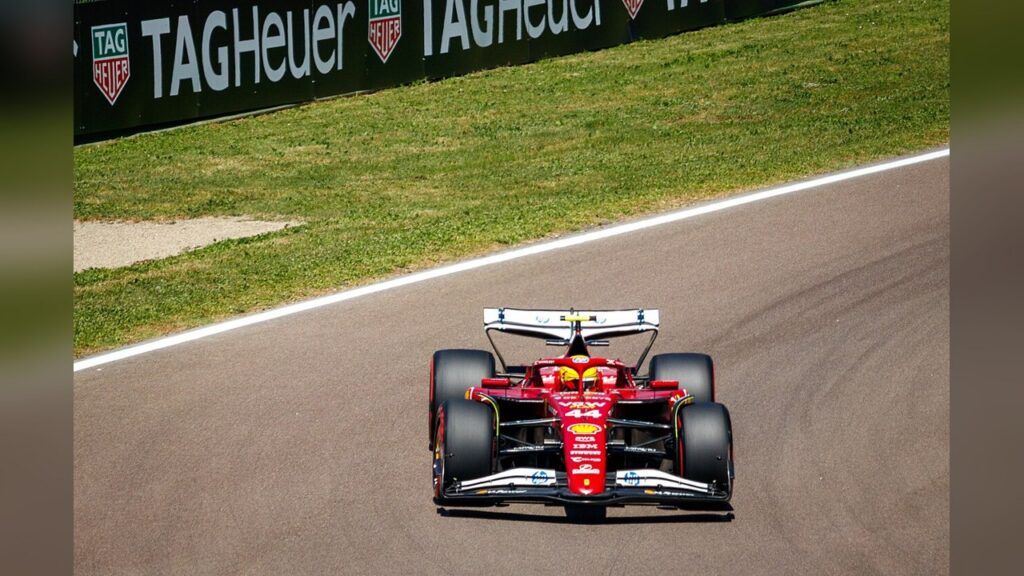
Lewis Hamilton smashed his Ferrari into the barriers at the exit of Fagnes during Saturday’s third free practice at Spa-Francorchamps, and his mechanics performed what amounted to a full rebuild between sessions to get him onto the grid for qualifying. They succeeded. The car just wasn’t quite the car he’d been driving all morning.
“I think something wasn’t the same on the rear suspension, so the balance wasn’t the same as I had in FP3, when the car was feeling really great,” Hamilton told Motorsport.com. “The guys did a great job repairing the car and these things happen, you move on. I did the best I could in qualifying, I think my laps were pretty decent.”
The specification of Hamilton’s SF-26 did not change. But the rush to reassemble it before qualifying left a subtle set-up imbalance — tilted toward the rear end — that Hamilton estimated cost him one or two tenths per lap. At Spa, where the gap between a good Saturday and a great one is measured in hundredths, that is not a rounding error. It is a grid position. Maybe two.
And yet Hamilton still qualified sixth, a mere 0.002 seconds behind Ferrari teammate Charles Leclerc in fifth. Two-thousandths of a second. Blink and you’ve missed an entire qualifying battle between the two scarlet cars. On paper, fifth and sixth is a logical result for Ferrari at a circuit where the team expected its power-unit deficit to Mercedes to be an insurmountable hurdle — Spa’s layout features roughly 50% more straights than a typical Formula 1 track, amplifying every horsepower gap.
Leclerc, for his part, had his own qualifying grievance: an erroneously displayed yellow flag disrupted his final push to challenge George Russell. So both Ferraris left time on the table, just for different reasons.
Polesitter Kimi Antonelli led the field, nearly half a second clear of Hamilton. When asked whether that deficit was primarily down to the power unit, Hamilton was measured. “I’m not quite sure, I haven’t seen the overlay, so I definitely know in my last sector I was losing some. But they’ve been up on deployment all weekend and we expected it on the track when you have 50% more straights.”
What stings for Hamilton is that FP3 had been genuinely promising. The car was balanced, the long runs were strong, and the seven-time champion believed he had something to work with. Then came the crash at Fagnes, the frantic garage rebuild, and a car that responded just differently enough to leave him guessing through every sector.
“They pushed right until the last minute to get the thing fixed, so I’m just grateful they did and I hope the car is still OK in the race,” Hamilton said. “In FP3 the car was feeling really good and I did a bit of a long run and the car was feeling great. It is a slightly different, subtly different car set-up wise, so I’m still hoping it’s good for tomorrow.”
That is the gamble. The repaired Ferrari carried Hamilton to within two-thousandths of his teammate on a compromised set-up. If the balance holds over a race distance and the Mercedes power advantage narrows in race trim rather than qualifying trim, Hamilton’s Sunday could look very different from his Saturday. If the rear-end gremlin persists through 44 laps of Spa, sixth may be the ceiling.
Either way, the margin between frustration and optimism at Maranello right now is 0.002 seconds and a rear suspension that nobody can quite pin down.