
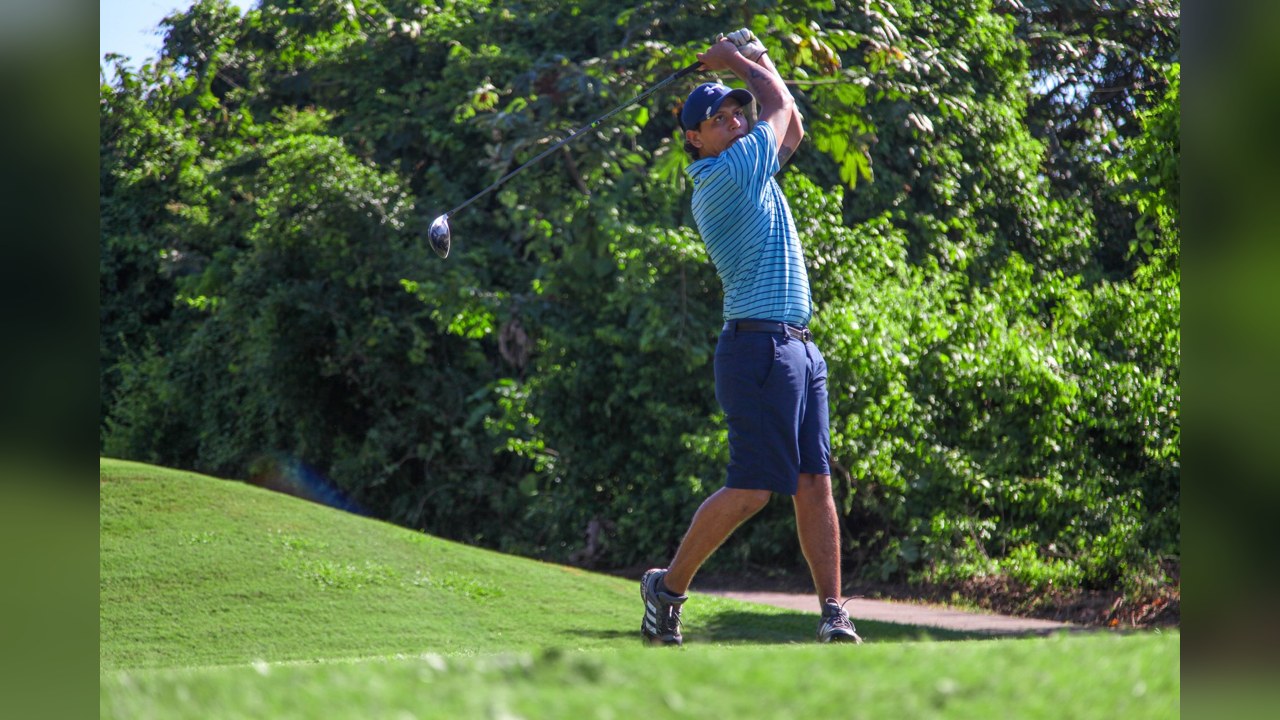
SOUTHPORT, England — Jackson Suber had never set foot in Europe before this week. Now he’s on a leaderboard at the Open Championship, and the thing everyone wants to talk about is his hands.
Specifically, how they’re wrapped around the club in a grip so strong that Golf Channel analyst Brandel Chamblee called it “the strongest grip I’ve ever seen from someone playing high level golf.” People have been telling Suber to fix it for years. He didn’t. He found a coach instead.
That coach, Troy Denton — who also works with Will Zalatoris and Ryan Moore — didn’t touch the grip. He rebuilt the path. Suber’s in-to-out swing was producing draws that ran too hot, the same mechanical trap that has nagged Rory McIlroy. Denton got Suber’s arms and club more in front of his body, allowing him to rotate aggressively through impact without the face flipping shut.
“I feel like my path is a lot more zeroed,” Suber said. “I’m hitting more of a shot that falls to the left, kind of not really a sweeping draw.”
The numbers back it up. Per ShotLink data, Suber is one of just 35 PGA Tour players whose stock tee shot is a draw. He averages a modest 15.2 yards of right-to-left movement, paired with 294 yards of carry and 178 mph ball speed. The ball doesn’t curve less because he weakened his grip. It curves less because his body controls the face now.
Suber’s links-golf education has been refreshingly blunt. “I knew the ball was going to be the same size, so that’s always nice,” he said. The plan: account for the runout, avoid the pot bunkers, and remember that the game is still the game.
Not everyone adapted so smoothly. Matt Fitzpatrick arrived at Royal Birkdale as a favorite — three PGA Tour wins this season, a strong Scottish Open — and left Friday at four-over par, posting twin 72s. It was his first missed cut in a major since the 2024 U.S. Open and his first missed Open weekend since 2018.
Fitzpatrick’s post-round assessment was equal parts frustration and fatalism. He described three shots Friday that came off exactly as intended: one finished in a bush, another briefly rested on the green before toppling off, and a third — hit with 15 yards of downwind help — plugged in the face of a bunker.
“That’s the way links golf is,” he said. “You need to have that rub of the green sometimes, and I didn’t have it this week.”
He also noted something that caught him off-guard. Fitzpatrick played a practice round at Birkdale two weeks before the championship and found a course that was firm but green. What he got in competition was something crustier. “Now it’s just very, very firm,” he said. “Yeah, it’s just weird.”
The cut claimed its share of big names alongside Fitzpatrick. The Open uses a flat top-70-and-ties rule after 36 holes — no 10-shot safety net, no secondary cut. Only those who survive earn a share of the $17.75 million purse.
Royal Birkdale’s 321-yard par-4 fifth hole became a tactical laboratory on Friday. The lay-up camp teed off from the left side, hitting irons to about 230 yards of rollout to avoid a bunker and ridge, leaving a 110-yard wedge. Matt Wallace championed that route, citing the headwind and the simplicity of a 7-iron-wedge sequence.
The go-for-it crowd needed 289 yards of carry to clear the hazard and pot bunkers guarding the corner. Bryson DeChambeau tried it, leaked his drive right into the long grass, and made his only front-nine bogey.
Friday also produced two rounds of 62 — Lucas Herbert and Sam Burns matching the lowest 18-hole score in major championship history within 15 minutes of each other. Herbert holed four putts beyond 10 feet, including a 35-footer at the seventh. Burns needed only 21 putts, tied for the fewest in an Open round over the last 25 years, per statistician Justin Ray, and closed with a bunker shot for birdie at 18.
But the field average on Friday was 69.79, meaning those 62s were 7.79 strokes better than the field — impressive, but not enough to crack the top 200 statistical rounds in major history. Greg Norman’s 63 at Royal St George’s in 1986 beat the field by more than 10.5 shots. Context matters.
Suber, though, didn’t need a 62. He needed his grip, his coach, and the stubbornness to ignore everyone who said the first one was wrong.
Sources:
- Yahoo Sports: Jackson Suber grip and contention at Royal Birkdale
- Yahoo Sports: Matt Fitzpatrick on ‘weird’ Birkdale conditions
- Yahoo Sports: How the cut line is determined at Royal Birkdale
- Yahoo Sports: Every shot on Royal Birkdale’s driveable par 4
- Yahoo Sports: How good were the 62s shot at Royal Birkdale?