
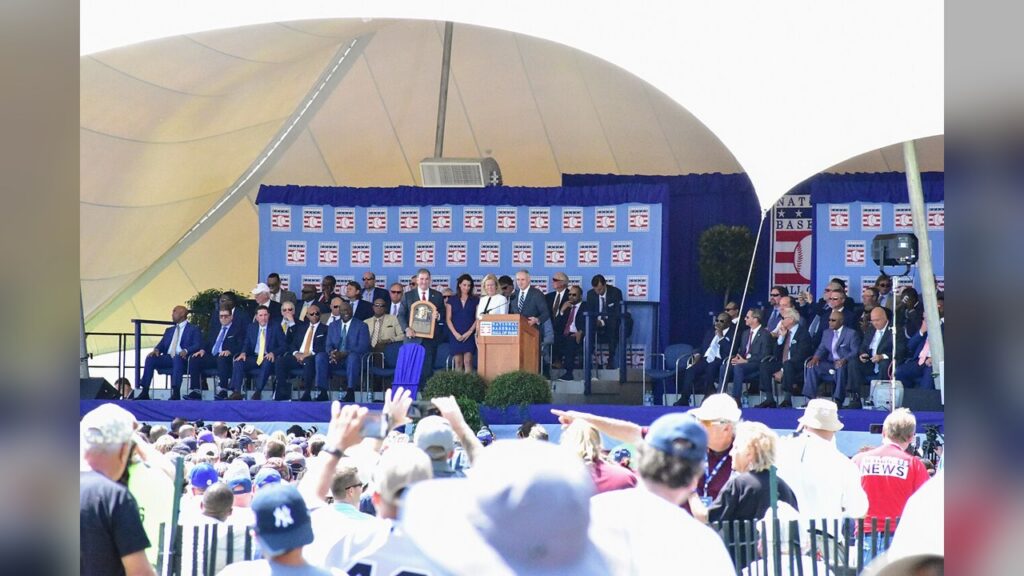
The National Baseball Hall of Fame inducted Andruw Jones, Carlos Beltrán, and Jeff Kent on Sunday in Cooperstown, New York, with more than 60 returning Hall of Famers gathered at the Clark Sports Center to welcome the newest class.
All three inductees delivered speeches that traced unlikely paths to the same stage.
Jones, the 10-time Gold Glove center fielder who spent a dozen seasons patrolling the outfield for the Atlanta Braves, became the first player from Curaçao to reach Cooperstown. He is the eighth member of the 1990s Braves dynasty enshrined and the 12th player to wear the Braves’ “A” on his plaque. His No. 25 is retired in Atlanta.
The arc of Jones’s candidacy is the kind of ballot trajectory that makes Hall of Fame voting a fascinating longitudinal study. In 2018, his first year on the Baseball Writers’ Association of America ballot, just 7.3% of voters checked his name. According to The Athletic, no player eventually elected by the writers has ever started from a lower floor. Nine years later, the resume that drew skepticism — a .254 career average, 434 home runs, and defensive metrics that rank among the best ever at his position — proved durable enough to carry him across the threshold.
Jones spoke about his father, Henry, who died 10 years ago and who coached him in Curaçao, hitting fly balls from foul pole to foul pole so his son could learn to track balls through ocean breeze. He thanked Bobby Cox, the Hall of Fame manager who died in May, for putting a 19-year-old in a World Series lineup. Jones homered in his first two World Series at-bats in 1996, becoming the youngest player ever to go deep in a Fall Classic — a record that still stands.
Beltrán, the ninth-round draft pick who became a nine-time All-Star, joined an exclusive club: only the sixth player from Puerto Rico to be enshrined. He brought roughly 150 family members and friends from the island. Over 20 seasons with seven clubs, Beltrán compiled 2,725 hits, 435 home runs, and 1,587 RBI, closing his career with a 2017 World Series title alongside the Houston Astros.
Kent’s route ran through the Contemporary Baseball Era Committee, which granted him enshrinement after 10 years on a crowded BBWAA ballot. The case the committee weighed was straightforward: no second baseman in major-league history hit more home runs than Kent’s 377. He drove in 1,518 runs across 17 seasons, posted eight 100-RBI campaigns, and won the 2000 NL MVP with a .596 slugging percentage, 33 homers, and 125 RBI — numbers compiled while Barry Bonds occupied the same lineup in San Francisco.
Kent opened his speech not with baseball but with a pickup truck. His father, a police officer in Southern California, bet him a truck in exchange for a college scholarship. Kent quit racing motorcycles, won the scholarship, and still keeps the truck in his garage. He credited Dusty Baker, his Giants manager, for reaching him on his level and simplifying a game Kent admitted he overcomplicated.
The ceremony also carried a quieter historical echo. This year marks the 150th anniversary of the National League, whose first president in 1876 was Morgan Bulkeley — a Hartford businessman who served a single ceremonial year before William Hulbert, the league’s true architect, took over. In 1937, when baseball executives selected the Hall’s first non-players, they inducted Bulkeley as a “pioneer.” Modern historians, including MLB’s official historian John Thorn, believe the committee likely meant to honor Hulbert. Bulkeley, who went on to serve as Connecticut’s governor and a U.S. senator while spending four decades as president of Aetna, remains enshrined regardless.
As historian Kevin Murphy wrote in his 2010 biography of Bulkeley: “He remains enshrined at Cooperstown — and probably always will.”
Sources: