
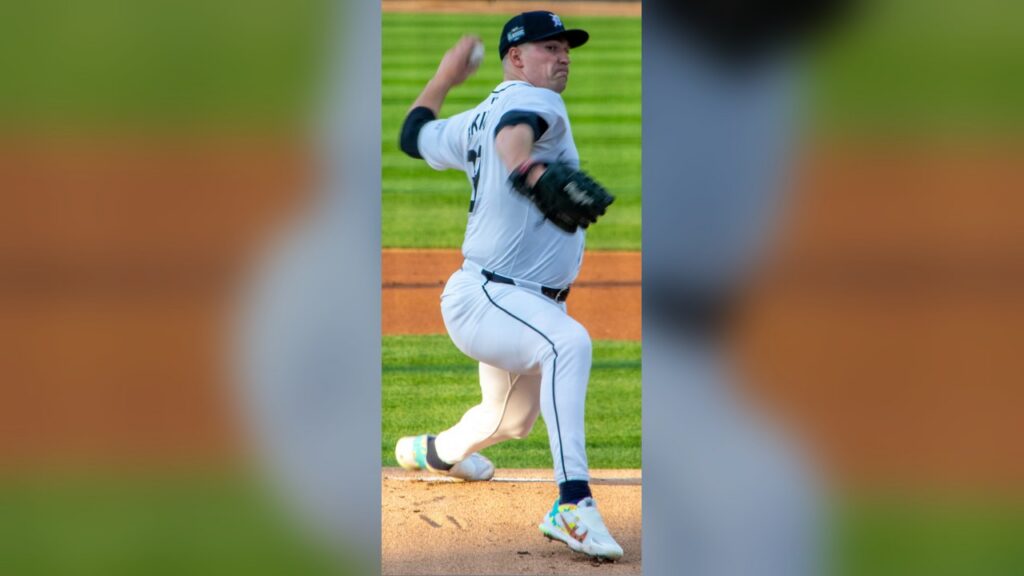
Tarik Skubal walked off the Comerica Park mound to a standing ovation from 40,638 fans on a 77-degree Friday night, and the numbers say they were applauding something close to peak Cy Young form. Skubal struck out a season-high 12 Kansas City Royals over 7⅓ innings, scattering four hits and two walks on 91 pitches in a 2-1 Tigers win — their third straight and 13th in 18 July games.
Through six innings, Skubal generated whiffs on 21 of 42 Royals swings — a 50% whiff rate. To put that in context: the MLB leader in whiff rate entering Friday was Padres closer Mason Miller at 47.6%, and Miller works one inning at a time. Skubal was doing it deep into a start, with seven of those 11 changeups producing empty swings. He struck out Salvador Perez in the sixth for his 10th punchout, blew a changeup past Vinnie Pasquantino to lead off the seventh for No. 11, and got Isaac Collins two batters later to set the season high.
The performance carries weight beyond the box score. Skubal is a two-time Cy Young Award winner and a pending free agent, widely regarded as the crown jewel of the Aug. 3 trade deadline. He admitted to reporters Thursday that Friday could be his final home start in a Tigers uniform. The Athletic places Detroit’s playoff odds at 28.3% and their World Series odds at 2.4% — steep but not negligible, especially in an American League having one of its weakest seasons in memory.
What makes the decision genuinely tortuous is that the Tigers keep winning. They’re 28-16 since June 1, sitting 50-54 — the closest they’ve been to .500 since mid-May — and just 3½ games back of the final AL wild-card spot. A 6-22 May had them pegged as slam-dunk sellers. That surge has complicated the math considerably.
Skubal’s own trajectory compounds the puzzle. He underwent a NanoNeedle procedure in May to remove loose bodies from his elbow and returned in 38 days. In seven starts since coming back, he owns a 2.70 ERA with a 65-to-6 strikeout-to-walk ratio. Over his last five outings: 1.45 ERA, 44 strikeouts against 19 hits and four walks in 30⅓ innings. He’s coming off a seven-inning shutout of the Angels. The arrow is pointing straight up at exactly the moment the franchise must decide whether to cash him in or ride him into October.

The Athletic reported that one path Detroit has considered, if it trades Skubal, is targeting a package headlined by a controllable major-league starter — names like the Dodgers’ Emmet Sheehan, the Phillies’ Andrew Painter, or the Yankees’ Will Warren — plus quality prospects. The starter would backfill Skubal’s rotation spot. The catch: none of those arms is close to Skubal’s level, and the Brewers’ 2022 Josh Hader trade looms as a cautionary tale of how dealing an elite arm mid-push can suck the life out of a clubhouse.
MLB Trade Rumors flagged another wrinkle: the Tigers are approximately $1.6 million over the luxury tax threshold. If they exceed $244 million and Skubal departs in free agency after a qualifying offer, their compensation pick drops from the end of the first round (slot value ~$3.2 million) to after the fourth round (~$569K). That’s a $2.6 million gap in draft pool money. Staying under the line — perhaps by moving Kenley Jansen ($11 million) or Kyle Finnegan ($9.5 million) — could preserve the better pick even if they keep Skubal and add around the margins.
Skubal is lined up to pitch Wednesday against the Orioles at Comerica Park. His next start after that would come on the road, shortly after the deadline passes. Every time he takes the ball and does what he did Friday, the case for holding on to him grows louder — and the price of letting him go gets steeper.

Regardless of where he finishes 2026, Skubal is expected to challenge Yoshinobu Yamamoto’s $325 million contract for the largest pitcher deal in MLB history this winter. Friday night, on 91 pitches, he offered a reminder of why.