
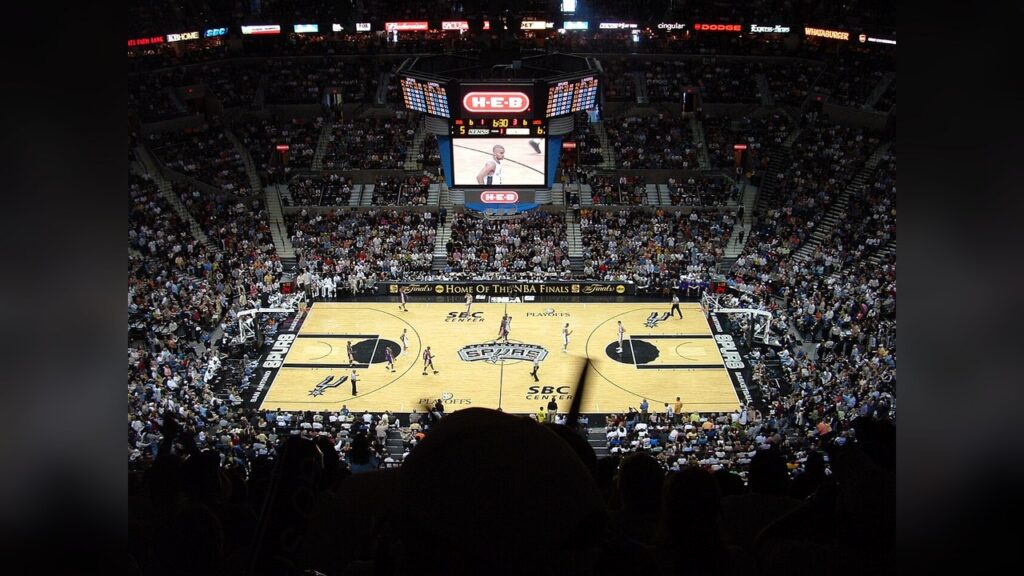
The 2001 Western Conference Finals had everything a ratings executive dreams about. The defending champion Lakers against the top-seeded Spurs. The two best records in basketball. The last two NBA champions squaring off. A regular season split, 2-2, that promised seven games of tension.
It lasted four. The average margin was 22.2 points.
San Antonio lost Game 3 by 39 and Game 4 by 29. The Alamodome went silent. Staples Center didn’t even need to get loud. The Lakers led Game 4 by 23 at halftime and coasted to a 111-82 finish, completing an 11-0 run through the Western Conference playoffs and extending a winning streak to 19 games across the regular season and postseason combined.
So what happened? The matchup looked even on paper. It wasn’t even close on the court.
Start with Kobe Bryant, who decided this was the series where he stopped being Shaquille O’Neal’s talented sidekick and became a nightmare nobody could guard. Across four games, Bryant averaged 33.3 points, 7.0 rebounds, and 7.0 assists on .514 shooting. He was 22 years old. The Spurs had no wing defender who could stay in front of him, and the numbers prove it — he played nearly 42 minutes per game and tormented San Antonio from every spot on the floor.
O’Neal was O’Neal: 27.0 points and 13.0 rebounds on .541 shooting. The Spurs’ Twin Towers were supposed to be the answer. They were the problem. Tim Duncan posted 23.0 and 12.3 per game but shot .478 — functional, not dominant. David Robinson shot .407 from the field, averaged 14.3 points, and spent the series looking like a man trying to move a wall that wasn’t moving back.
Then there was Derek Fisher, who turned in one of the most efficient four-game stretches of his life: 17.5 points on .614 shooting, including .750 from three-point range. Fisher went 15-of-20 from deep in the series. Game 4 was his signature performance — 28 points on 11-of-13 shooting, 6-of-7 from three, outscoring both Shaq and Kobe on the night the Lakers closed the door.
The Spurs’ offense collapsed entirely. As a team, San Antonio shot .384 from the field and .220 from three across the series. They scored 81.3 points per game. The Lakers scored 103.5. That 22.2-point differential isn’t a rounding error — it’s a demolition.
One critical factor that gets overlooked: Derek Anderson. The Spurs’ second-leading scorer during the regular season had been injured in the second round against Dallas when Juwan Howard delivered a hard foul that separated Anderson’s shoulder. Anderson tried to play in the WCF but was a ghost — two appearances, 41 total minutes, 0-for-10 from the field, four points. San Antonio’s backcourt depth evaporated overnight. Antonio Daniels (19.0 PPG) and Terry Porter (6.3 PPG on .345 shooting) couldn’t compensate. Avery Johnson managed 6.3 points on .367 shooting. The Spurs’ guard play was a black hole, and the Lakers’ perimeter defense feasted on it.
The 2001 Lakers finished the playoffs 15-1, their only loss coming in overtime of Game 1 of the NBA Finals against Allen Iverson’s 76ers. They went 8-0 on the road. They swept three consecutive series. The Spurs series was supposed to be the test. Instead, it was the coronation.
San Antonio had home-court advantage, 58 wins, and the reigning league MVP in Duncan. None of it mattered. The Lakers didn’t just beat the Spurs — they made them look like a first-round opponent who showed up to the wrong gym.
Sources: