
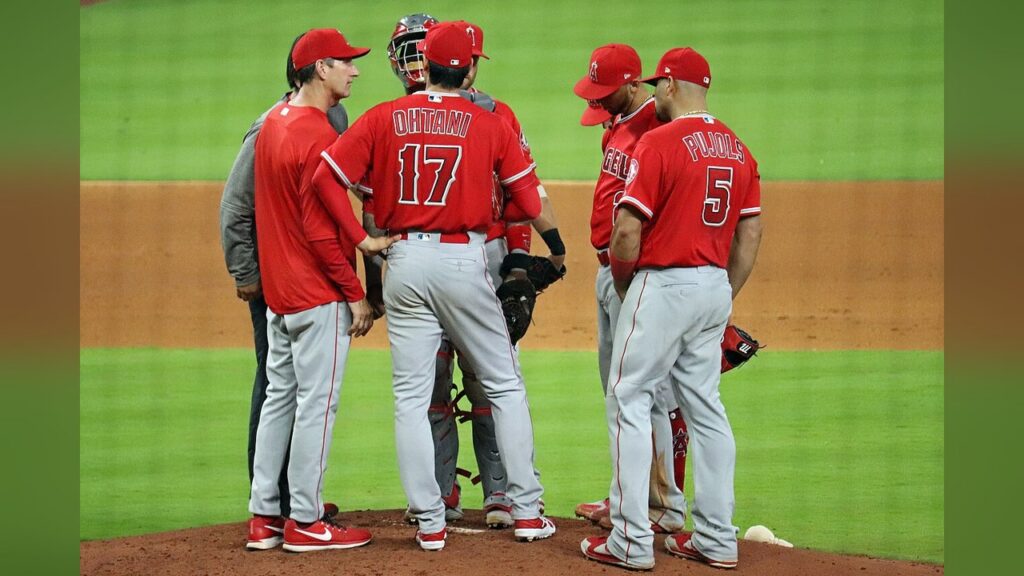
Shohei Ohtani threw a bullpen session at Citizens Bank Park this week — 31 pitches, full repertoire, first time off a mound since doctors drained his left knee and injected a cortisone shot over the All-Star break. He will keep hitting. He will not start on the mound for a few more weeks, at minimum.
And so the question that a fan posed to the baseball internet this week — the one that got people arguing into the replies — lands at exactly the right moment: When do we admit Ohtani is damaged goods as a pitcher?
It is the wrong question. But it is not a stupid one.
The case for “damaged goods” writes itself. Two Tommy John surgeries. A grand total of 14 starts in 2025. A knee drained midseason in 2026. Every time the mound chapter seems ready to open fully, the body files another objection. The fan who raised the point named a grim roll call — Johan Santana, Tim Lincecum, Corey Kluber, Jacob deGrom — aces whose arms gave out while the rest of them still wanted to compete. The comparison is understandable. It is also, at least so far, wrong.
When Ohtani returned to a major-league mound in June 2025, more than 53,000 people packed Dodger Stadium to watch him throw one inning. He touched 100 mph. By season’s end, his average four-seam fastball velocity had reached a career high — 98.4 mph, fifth among all starting pitchers, and harder than he threw before the second elbow surgery. His max velocity hit 101.7. He reached triple digits 49 times.
The strikeout-to-walk ratio was 6.89, second among starters with at least 10 appearances, behind only Cy Young winner Tarik Skubal. He added a new hard slider that generated a 44% whiff rate. He resurrected his splitter for the postseason and used it to strike out Bryce Harper and Kyle Schwarber in the NLDS, then recorded the final five strikeouts of his NLCS clincher against the Brewers — six scoreless innings, 10 strikeouts, three home runs at the plate, in what multiple outlets called the greatest single-game performance in baseball history.
The 2026 numbers, even with the knee interruption, are absurd: 8-2, 1.79 ERA, 0.95 WHIP, 95 strikeouts. As a hitter, .283 with 22 home runs and 60 RBIs. He won his third consecutive MVP. He is not Santana, whose shoulder simply stopped working. He is not Lincecum, whose velocity collapsed and never returned. Ohtani’s stuff, by every measurable standard, is nastier now than it was before the surgeries.
The problem is not the quality. The problem is the quantity. The Dodgers have wrapped him in a six-man rotation, managed his workload with surgical care, and still the interruptions come — elbow, elbow, now knee. He has pitched roughly 90 innings across two seasons for Los Angeles. That is not an ace’s workload. It is a part-time pitcher’s workload, even if the part-time pitcher might be the best in the sport when he shows up.

Dave Roberts has said the plan is for Ohtani to start, and the organization remains committed to the two-way vision for 2026 and beyond. The knee, unlike the elbow, is not a career-threatening structure for a pitcher. But the pattern — brilliant when available, frequently unavailable — is real, and it is fair to wonder whether 100 innings a year is the ceiling, not the floor.
The fan’s instinct was right even if the diagnosis was wrong. Ohtani is not damaged goods. He is something stranger and more frustrating: a pitcher who might be better than ever, in smaller and smaller doses.
Sources: