
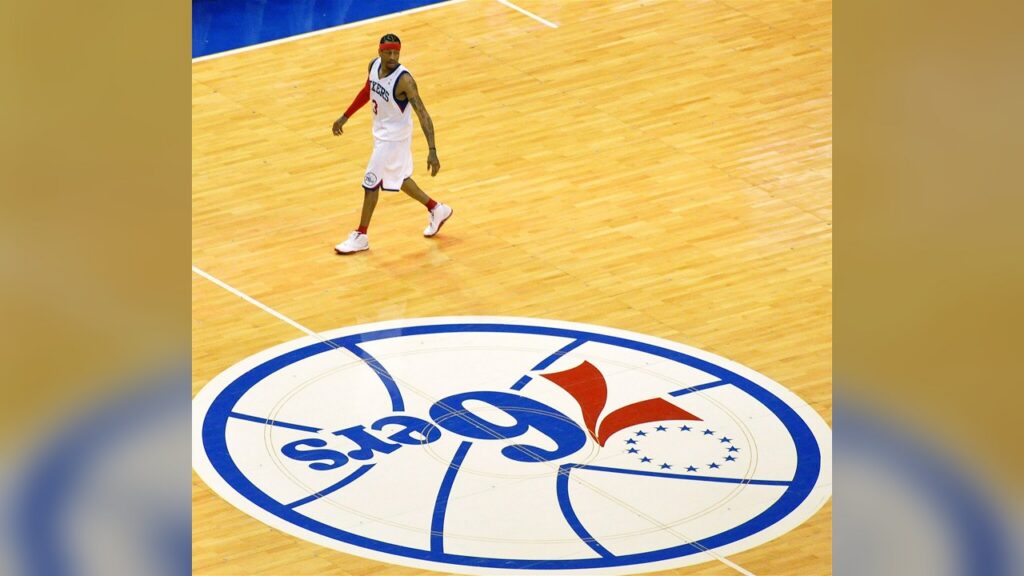
The question circulates every few weeks in NBA corners, and it circulated again this week: Are the Philadelphia 76ers a superteam? The premise is fair enough on paper. Joel Embiid is a former MVP. Paul George is a nine-time All-Star. Tyrese Maxey is an ascending All-NBA talent. Daryl Morey stacked three max contracts on one roster and pushed the franchise hard against the second apron to do it. By the logic that named the 2017 Warriors and the 2021 Nets, the Sixers fit the template.
They fit the template the way a blueprint fits a building. The structure is there. The load-bearing components did not hold.
The 2025-26 season — now complete — produced a 45-37 record. That is a winning season. It is not a superteam season. The 2017 Warriors won 67 games. The 2018 Warriors won 58. The 2021 Nets, the last team most observers agree earned the label, went 48-24 in a 72-game season — a 55-win pace. The Sixers won 45 of 82 and finished with a point differential that hovered around league average for long stretches. They beat good teams and lost to bad ones with a frequency that superteams do not tolerate.
The core problem is availability, and availability is a skill. Embiid played 38 games. George played 37. Together, the two highest-paid players on the roster — combining for roughly $107 million in salary — appeared in 75 of a possible 164 slot-games. Embiid, when active, produced at a near-elite level: 26.9 points per game on .527 true shooting, 7.7 rebounds, 3.9 assists. George, at 35, slipped to 17.3 points on .536 true shooting — respectable for a role player, startling for a max earner. The gap between his name and his production widened with every month.
Maxey was the engine. He played 70 games, averaged 28.3 points and 6.6 assists, earned an All-Star selection and All-NBA Third Team honors, and carried the offensive load for a roster that needed him to be both its primary creator and its most durable star. Rookie VJ Edgecombe, the third overall pick, started 75 games and finished third in Rookie of the Year voting at 16 points per game. Quentin Grimes and Kelly Oubre Jr. provided wing scoring in complementary roles. The supporting cast was adequate. The stars were not.
The financial architecture compounds the problem. According to Spotrac, the Sixers carry approximately $200 million in total cap allocations against a $154.6 million league cap — $45 million over the threshold and hard-capped at the second apron. Embiid, George, and Maxey alone account for roughly $145 million. That commitment leaves no flexibility to absorb the cost of two stars who cannot stay on the floor. The second apron restricts trade aggregation, eliminates the mid-level exception, and freezes salary-matching options. Morey built a superteam budget for a roster that performed like a play-in contender.

The 2021 Nets offer the cleanest counterpoint. Kevin Durant, James Harden, and Kyrie Irving were all in their primes — or close enough that the distinction barely mattered. The Sixers’ trio includes a 31-year-old center with a chronic knee condition, a 35-year-old wing in visible decline, and a 25-year-old guard who has not yet entered his ceiling. That is not a superteam. That is one star and two question marks, priced like three certainties.
The 45-37 record is the receipt. Superteams do not lose 37 games.