
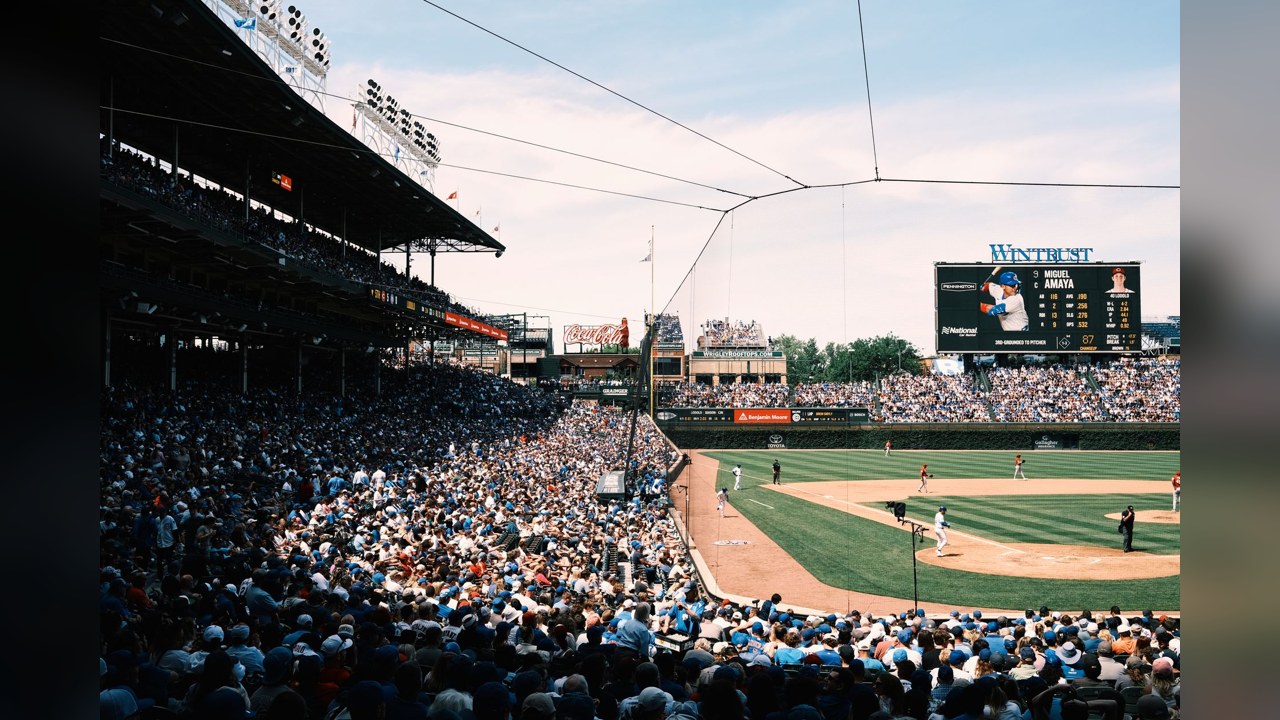
The 2016 Chicago Cubs came back to Wrigley Field over the weekend, and for three days the place turned into a rolling nostalgia machine. Bill Murray and Eddie Vedder were there. David Ross and Anthony Rizzo hosted a two-hour podcast at the Chicago Theatre. Kyle Hendricks threw out a ceremonial first pitch. On Saturday, the franchise unveiled a 22-foot “Champions Gate” outside the ballpark honoring its three World Series title teams, with Joe Maddon, Rizzo, and owner Tom Ricketts addressing the crowd.
Then Michael Busch hit a home run into the right-field bleachers — where the 2016 squad was sitting with drinks in hand — and the ball landed at Rizzo’s feet while he held his infant son. Rizzo, wearing his Game 7 jersey, called it “the best few days in the last 10 years of my life.”
The reunion was a celebration. The subtext was a deadline.
This year’s Cubs are 54-42, sitting in the top NL Wild Card spot, six games behind the Brewers in the Central. The first half was a statistical fever dream: two separate 10-game winning streaks, a 10-game losing streak, a 20-8 surge into the All-Star break. They rank fourth in OPS. Their defense grades out well. The offense, though inconsistent, has produced runs at a clip that suggests a legitimate October contender.
The pitching does not. The Cubs carry a 4.33 team ERA — 21st in baseball. Jameson Taillon is expected back this week, Edward Cabrera in roughly three, and closer Daniel Palencia is out until at least mid-August. Jed Hoyer, now running the front office, has already burned through his rotation depth and been forced to trade for and claim arms just to survive the first half.
“You can’t have enough pitching,” Hoyer said. “You never have enough. This first half has kind of proven that. We thought we went in with real depth and we got to the end of our depth.”
The 2016 template is sitting right there. Theo Epstein’s Cubs already had Jon Lester, John Lackey, Hendricks, and a Cy Young-level Jake Arrieta — 18-8 with a 3.10 ERA that season after going 22-6 with a 1.77 the year before. They still traded top prospect Gleyber Torres and Adam Warren to the Yankees for Aroldis Chapman at the deadline. Epstein’s reasoning became the franchise’s unofficial motto: “If not now, when?”
Epstein, back in town for the reunion, put it this way Saturday: “It’s one thing to assemble a bunch of talent. It’s another thing to have that group turn into a championship team that stands up in the face of adversity at the most important times.”
Hoyer’s calculus is more clinical. He told reporters he tries “to stick to the numbers and make sure we’re doing things that make sense on paper.” The equation he’s working through: the Cubs’ position-player group is “really, really good” and “could win a lot of games in October.” The challenge is “pitching and pitching injuries.” San Francisco’s Robbie Ray, the Giants’ No. 2 starter, was floated in the Yahoo Sports report as an ideal target.
There’s also a structural argument for aggression. Hoyer emphasized that securing a first-round bye — awarded to the league’s top two records — is “effectively winning a series and weakening your opponent in the next series.” Last year’s Cubs made the playoffs as a wild card, got bounced by the Brewers in the NLDS after being forced to start Matthew Boyd on short rest, and went home. The gap between a bye and a best-of-three opening round is the gap between a rested rotation and a patched-together one.
The Brewers’ six-game lead complicates the math. If the Cubs close ground before the July 31 deadline, Hoyer is expected to push for a front-line starter and bullpen help. If they slide backward, the approach turns passive. The front office will let the standings dictate the spend.
“There’s some sense of urgency,” Hoyer said, and the sentence trailed off the way it does when a man is still running the numbers.