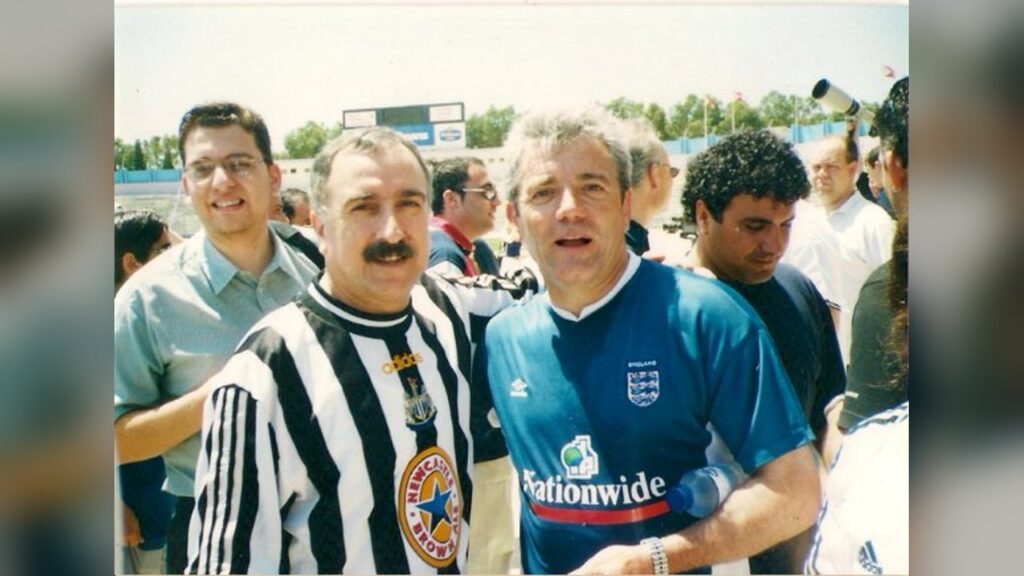
Kevin Keegan — two-time European Footballer of the Year, Liverpool icon, Newcastle messiah, and former England manager — has died at 75 after a battle with stage four cancer, his family confirmed Monday.
“It is with immense sadness that we announce that Kevin Keegan has passed away at the age of 75,” the family’s statement read. “The former England player and manager had been battling cancer and was surrounded by his wife and daughters in his final moments.”
Keegan was diagnosed in January. By June, he publicly confirmed the cancer was stage four. He is survived by his wife Jean and their daughters.
The résumé reads like a man who couldn’t help but win wherever he laced them up. Four First Division titles at Liverpool. The 1977 European Cup — the club’s first. Two UEFA Cups. An FA Cup. Back-to-back Ballon d’Or honors in 1978 and 1979, a feat no Englishman has matched since. Then a move to Hamburg and two Bundesliga titles, because apparently one country’s silverware wasn’t enough.
Liverpool called him “Mighty Mouse” and a “bona fide superstar,” noting he arrived from Scunthorpe as a 20-year-old in 1971 and scored on his debut against Nottingham Forest. His partnership with John Toshack became the engine of Bill Shankly’s second great Liverpool side. He signed off at Anfield by firing 20 goals en route to a third league medal and that maiden European Cup.
“One of the greatest players this country has ever produced,” Jamie Carragher wrote. “Trophies and goals galore. Double Ballon d’Or winner shows he was an absolute giant of the English game. One of the most important men in making LFC what it is today.”
Former Liverpool striker John Aldridge, who watched Keegan from his first match at Anfield, called him “electrifying.” He added: “There’s a saying, ‘never meet your heroes.’ I’ve been lucky enough to meet mine. He surpassed everything.”
But it was at Newcastle United where Keegan became something more than a footballer. They called him “King Kev.” He took the club from the second tier to the Premier League and drove them to their best-ever finish — second — with a swashbuckling style that turned St. James’ Park into the most electric ground in England. He signed Alan Shearer for a then-world-record fee, and Shearer repaid the faith with a tribute that needed only five sentences: “My Hero. My manager. My friend. Sleep easy Boss.”
Newcastle’s statement was sprawling and raw. “Kevin was more than a legendary footballer and manager,” the club wrote. “He was the beating heart of Newcastle United for generations of supporters.” They called him “a true giant of our history” and promised a lasting tribute at the appropriate moment.
He earned 63 England caps, scored 21 goals, and captained the side 31 times before retiring from international duty after the 1982 World Cup. He managed the Three Lions from February 1999 to October 2000, resigning after a 1-0 defeat to Germany at the old Wembley — a man who always knew when the plate was clean. He later managed Manchester City, guiding them to promotion as Division One champions in 2002.
Southampton, where Keegan played from 1980 after arriving as the reigning Ballon d’Or holder, also paid tribute. The EFL and the official England account acknowledged his passing. Manchester City called him “a transformative manager who brought optimism and vibrancy.”
Nearly 750 club appearances. Trophies in three countries. Two Ballon d’Ors. A nickname that stuck like a tattoo. Not a bad shift for a kid from Scunthorpe.