
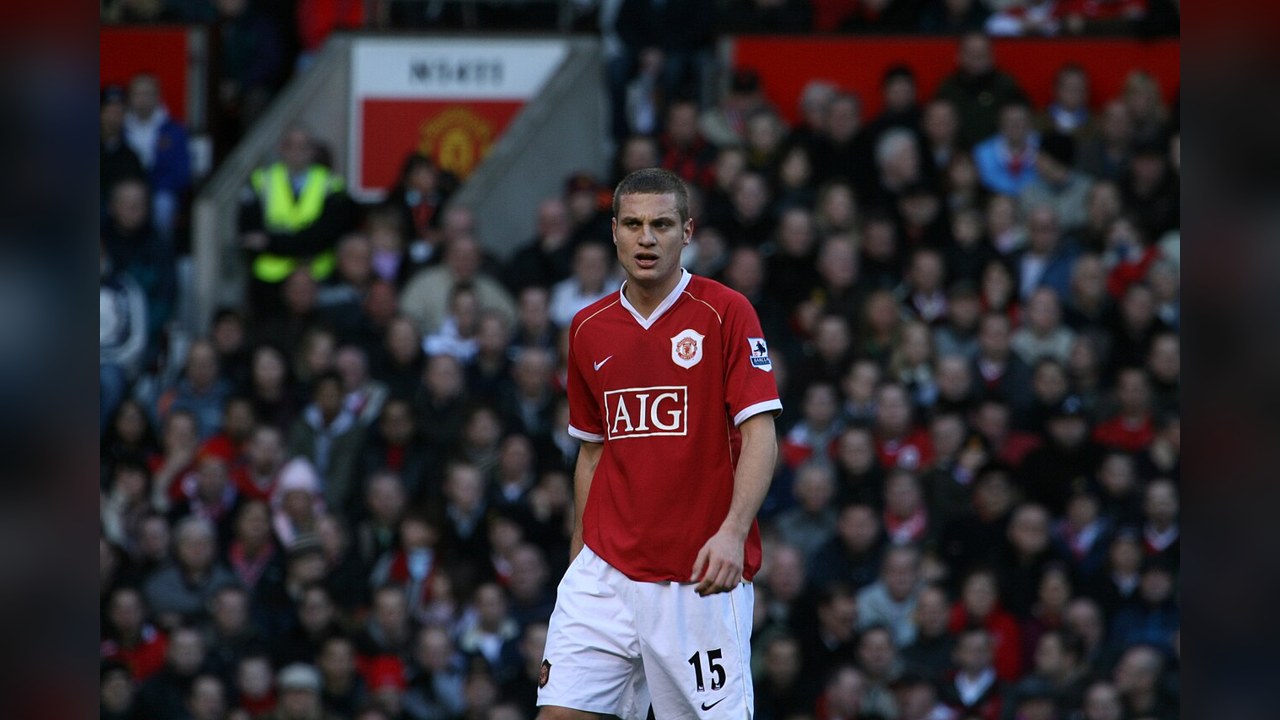
Nemanja Vidic spent nine years in Manchester planting elbows into strikers and collecting Premier League titles, so when the man who once marshaled United’s back line says he responded to death threats with sarcasm, you believe him. “I said something like: ‘Well, that will be interesting if I ever write a book,'” Vidic told The Athletic’s Andy Mitten, in his first English-language interview about the ordeal.
Then he read the messages.
The threats, uncovered by the Organised Crime and Corruption Reporting Project (OCCRP) and Serbian investigative outlet KRIK, were allegedly sent by Slavisa Kokeza, the former president of the Football Association of Serbia (FSS). Vidic had written an open letter to the FSS after Serbia’s penalty-shootout loss to Scotland in the Euro 2020 qualifying playoff — a defeat that denied the nation a place at the tournament, held in 2021 after a COVID delay. As Serbia’s most famous player and a former United captain, his words carried weight. What followed, The Athletic reported, “resembles more of a gangster film” than a football federation’s response to criticism.
The messages, obtained by OCCRP and KRIK and reviewed by The Athletic, told Vidic to “stay away from the association or he will end up in a ditch.” Another referenced the subject going “to the cemetery.” The sender described himself as “the president of the association,” widely believed to be Kokeza. A GPS tracker was fitted to Vidic’s car. Other former Serbia internationals — including Nemanja Matic, Danko Lazovic, and Dragan Mrda — were discussed in the same communications, with efforts to intimidate them into withdrawing support for Vidic.
“I was surprised to be told Slavisa Kokeza had spoken to people about me,” Vidic said. “That I had a tracker fitted to my car. That bad people were talking about attacking me.”
Vidic insisted he was not personally frightened but acknowledged the toll on his family. “It was different for my family when they read these things,” he said. He noted that no police or authority had contacted him about the situation before the journalists approached him. Friends had warned him at the time — “Listen, Vida, you should be careful” — friendly advice he initially treated as paranoia.
His motivation for speaking out, he said, was simple. “I have only one regret in my life: that I didn’t achieve more with the Serbian national team,” Vidic said. “I spoke after Serbia didn’t qualify and people blamed players and coaches. It wasn’t about players and coaches, but people didn’t ask why we failed.” He emphasized he had no political ties or financial deals behind his criticism. “They were my thoughts and I was entitled to express them.”
Serbia’s subsequent failure to qualify for the expanded 48-team 2026 World Cup — finishing third in their group, one point behind Albania — offered little rebuttal to Vidic’s critiques.
The day after The Athletic’s interview, KRIK published a follow-up reporting that Serbian prosecutors had opened an investigation. The Public Prosecutor’s Office for Organised Crime confirmed in a statement that it had learned of the threats from KRIK’s reporting, established a case, and received a criminal complaint from Vidic’s attorneys. Prosecutors summoned Vidic to give a statement and requested that the Ministry of Internal Affairs collect all available SKY ECC communications — encrypted messaging data — relating to Kokeza and his contacts.
Kokeza resigned from the FSS in 2021. Neither he nor the federation responded to requests for comment from The Athletic or OCCRP.
Sources:
- Yahoo Sports / The Peoples Person — “Nemanja Vidic: Man United legend reacts to death threats in Serbia”
- The Athletic — Andy Mitten’s interview with Nemanja Vidic (original source; paywalled)